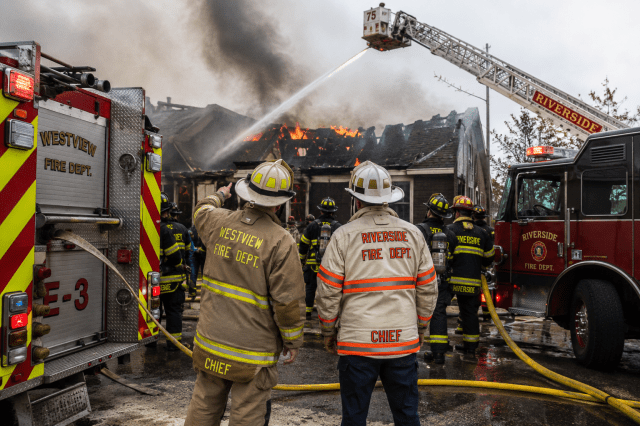
One of the greatest strengths of the American fire service is its willingness to help neighboring communities. Every day, fire departments respond across jurisdictional boundaries to assist one another on emergencies ranging from single-family house fires to large industrial incidents. Successful mutual aid operations are rarely the result of luck, they are built upon preparation, professionalism, and leadership.
For company officers, the arrival of mutual aid companies changes the dynamics of the incident. Different apparatus, equipment, terminology, radio procedures, and organizational cultures all converge on one emergency scene. The officer who understands how to integrate these resources effectively will improve both firefighter safety and incident outcomes.
Begin with Mutual Respect
Every department has its own traditions and operational methods. While those differences may seem significant around the kitchen table, they should disappear once the apparatus is placed in gear and the emergency begins.
Professional officers avoid criticizing another department’s equipment, staffing, or tactics during an incident. Instead, they focus on the common objective: solving the problem safely and efficiently. Mutual respect builds trust, and trust leads to better teamwork under stressful conditions.
Assume Nothing
One of the most dangerous assumptions an officer can make is believing that neighboring firefighters operate exactly like their own department.
Company officers should quickly determine:
- Staffing levels on each apparatus
- Available equipment
- Hose diameters and thread compatibility
- SCBA air cylinder compatibility
- Radio capabilities
- Specialized resources
- Water supply capabilities
Taking just a few moments to understand the capabilities of incoming companies allows assignments to match their strengths rather than their limitations.
Communicate Clearly
Communication problems account for many operational failures during mutual aid incidents.
Officers should avoid department-specific slang or local terminology. Instead, use standardized fire service language.
Rather than saying:
“Take the Smith Street stretch.”
Provide complete assignments:
“Engine 4, deploy a 1¾-inch attack line through the Alpha-side front door to the first floor for fire attack.”
Every assignment should answer four questions:
- Who is responsible?
- What is the assignment?
- Where is the assignment?
- What is the objective?
Clear assignments reduce confusion and eliminate unnecessary radio traffic.
Integrate Companies—Don’t Isolate Them
Whenever possible, combine personnel from different departments into functional groups rather than allowing agencies to operate independently.
Examples include:
- Attack team with one department advancing the line while another provides backup.
- Search groups composed of firefighters from multiple departments can divide up the task and clear the structure quickly.
- Ventilation coordinated directly with interior attack companies.
- Water supply operations utilizing apparatus from several jurisdictions.
Working together encourages communication and develops trust that carries over into future incidents.
Maintain Strong Accountability
Mutual aid increases the complexity of accountability.
Company officers should ensure:
- Every crew reports to a supervisor.
- PAR (Personnel Accountability Reports) are conducted regularly.
- Crew integrity is maintained.
- Freelancing is eliminated.
- Assignments are documented through the Incident Command System.
No company should begin work until it has received an assignment from Command.
Unassigned companies should stage in a designated location and await orders.
Understand Each Department’s Capabilities
Not every apparatus serves the same purpose.
Some neighboring departments may respond with:
- Engines
- Tankers
- Quints
- Heavy rescue companies
- Brush apparatus
- Squad companies
- Air units
- Rehabilitation units
Experienced officers understand these differences and assign resources where they provide the greatest value.
Coordinate Tactical Benchmarks
Mutual aid operations require continuous updates.
Company officers should communicate benchmark reports such as:
- Water on the fire
- Primary search complete
- Secondary search complete
- Ventilation completed
- Utilities controlled
- Fire under control
- PAR completed
These benchmarks allow Command to coordinate multiple companies without unnecessary radio traffic.
Standardize Training Before the Emergency
The best mutual aid incidents begin months before the dispatch.
Joint training should include:
- Hose deployments
- Water supply operations
- Rural water shuttle exercises
- Mayday procedures
- Rapid Intervention Team operations
- Search and rescue
- Ventilation coordination
- Incident Command System exercises
Training together allows firefighters to build relationships before lives depend upon them.
Know Each Other’s Equipment
Differences in equipment can slow operations.
Company officers should become familiar with neighboring departments’ equipment, including:
- Hose couplings
- Pump panel layouts
- Portable radios
- Thermal imaging cameras
- Ground ladders
- Forcible entry tools
- SCBA emergency procedures
Pre-incident familiarization visits between departments often identify compatibility issues before an emergency exposes them.
Stay Flexible
Every incident is different.
A neighboring department may possess greater experience with commercial buildings, technical rescue, or water supply operations than your own department.
Strong leaders recognize expertise regardless of the patch on someone’s sleeve.
The best officers are confident enough to accept suggestions and flexible enough to adjust tactics when conditions change.
Conduct Honest After-Action Reviews
Once the incident concludes, officers should evaluate the operation together.
Questions should include:
- What went well?
- Where were communication problems?
- Were assignments clear?
- Were accountability procedures effective?
- Did equipment compatibility create delays?
- How can future operations improve?
These discussions should focus on learning rather than assigning blame.
Every mutual aid response provides an opportunity to strengthen future partnerships.
Final Thoughts
The public does not distinguish between departments at an emergency scene. Citizens simply see firefighters working together to protect lives and property. They expect professionalism, competence, and teamwork regardless of the names on the apparatus.
For company officers, successful mutual aid leadership begins with humility, communication, and preparation. Building relationships before the emergency, assigning resources effectively, maintaining accountability, and treating every firefighter as part of one unified team transforms multiple departments into a single, coordinated organization.
When the tones sound, jurisdictional boundaries become lines on a map. On the fireground, there is only one mission: protect lives, support one another, and bring every firefighter home safely.

