
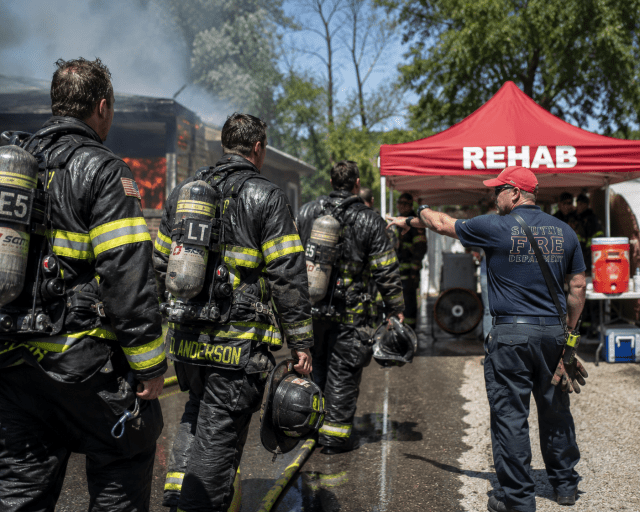
Summer has always challenged the fire service, but today’s increasingly frequent periods of extreme heat have raised the stakes. While firefighters train to work in dangerous environments, company officers must recognize that excessive environmental heat can become just as deadly as the fire itself. Heat stress is often silent, cumulative, and unforgiving. A firefighter who begins the shift is well-hydrated and motivated can rapidly become a medical emergency if officers fail to recognize the warning signs.
One of the greatest responsibilities of a fire company officer is ensuring that every firefighter returns home safely. During periods of extreme heat, that responsibility begins long before the first alarm is dispatched.
Preparation Starts Before the Call
Successful heat management begins at the station. Officers should encourage firefighters to arrive for duty already hydrated rather than trying to “catch up” after the temperature rises. Water consumption should be continuous throughout the day instead of waiting until thirst develops. Thirst is often a late indicator of dehydration.
Officers should also evaluate the day’s weather forecast. High temperatures combined with elevated humidity significantly reduce the body’s ability to cool itself through perspiration. A day with an ambient temperature of 95°F and high humidity can create conditions where firefighters begin accumulating dangerous heat loads before ever entering a burning structure.
Crew members should be reminded to:
- Drink water and electrolyte-replacement fluids regularly.
- Avoid excessive caffeine and energy drinks.
- Eat balanced meals to maintain energy.
- Wear lightweight station uniforms whenever department policy allows.
- Report any illness, medications, or previous heat-related injuries that could increase their risk.
Recognize That PPE Is an Insulator
Structural firefighting clothing is designed to keep heat out—but it also keeps body heat in.
Every minute spent wearing turnout gear increases the body’s core temperature. During hot weather, firefighters may begin sweating heavily before even arriving at the incident scene. Officers should recognize that donning full PPE for extended periods while awaiting assignments can unnecessarily increase heat stress.
Whenever operationally appropriate, personnel should remain out of full structural PPE until assignments require it.
Build Rehabilitation Into Every Incident
Rehabilitation should never be viewed as optional.
Whether operating at a working structure fire, vehicle fire, technical rescue, or lengthy training exercise, company officers should actively rotate crews through rehabilitation before fatigue becomes apparent.
Effective rehabilitation includes:
- Removal of helmets, gloves, hoods, and turnout coats whenever possible.
- Movement into shaded or air-conditioned areas.
- Active cooling with fans, misting devices, cooling towels, or forearm immersion.
- Fluid replacement with water and electrolyte beverages.
- Medical monitoring, including heart rate, blood pressure, and body temperature when available.
- Adequate recovery time before returning to operations.
Strong officers understand that rotating firefighters early keeps crews operating effectively much longer than pushing exhausted personnel until they fail.
Watch for the Quiet Signs
Heat-related illness rarely begins dramatically.
Many firefighters are reluctant to admit they are struggling. Pride, determination, and commitment to the team often cause firefighters to ignore early symptoms.
Company officers must continuously monitor personnel for:
- Unusual fatigue
- Slowed decision-making
- Irritability
- Poor coordination
- Excessive sweating—or the sudden absence of sweating
- Muscle cramps
- Headache
- Nausea
- Confusion
- Difficulty following simple instructions
The firefighter suffering heat illness is frequently the last person to recognize it.
Set the Example
Leadership is demonstrated more by actions than words.
If company officers refuse water breaks, remain in full PPE unnecessarily, or dismiss rehabilitation as weakness, firefighters will follow that example.
Instead, officers should openly hydrate, encourage cooling breaks, and normalize rehabilitation. Taking care of firefighters should never be mistaken for lowering operational standards. It is a hallmark of professional leadership.
Training Requires the Same Discipline
Some of the most serious heat injuries occur during training rather than emergency incidents.
Training evolutions often involve repeated physical exertion with fewer natural pauses than emergency responses. Officers should schedule strenuous activities during cooler morning hours whenever possible, shorten work cycles during extreme heat, and increase the frequency of rehabilitation periods.
Heat safety should be integrated into every training plan, not added as an afterthought.
Know When to Stop
There are times when environmental conditions require officers to modify tactics.
Additional companies may be needed simply to allow more frequent crew rotation. Non-essential training may need to be postponed. Exterior work periods may need to be shortened. Personnel exhibiting signs of heat stress should be removed from operations immediately.
Stopping one firefighter from becoming a patient preserves the effectiveness of the entire incident.
The Measure of Leadership
Firefighters expect difficult assignments. They willingly enter burning buildings, work in heavy protective clothing, and perform physically demanding tasks under extraordinary conditions.
What they deserve is leadership that recognizes when environmental conditions create unnecessary risk.
The best company officers understand that aggressive firefighting and firefighter safety are not opposing priorities, they are inseparable. A crew that remains hydrated, rested, medically monitored, and physically capable will consistently outperform an exhausted crew that has been pushed beyond its limits.
When temperatures soar, leadership is measured not by how long firefighters can endure the heat, but by how effectively their officers protect them from it.
At the end of every shift, every firefighter should return home with nothing more than the satisfaction of a job well done, not the lasting consequences of a preventable heat-related injury.

