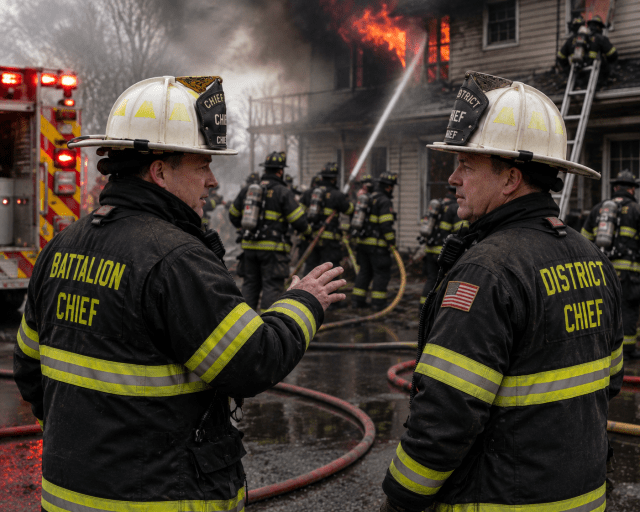
Fireground operations are built upon a foundation of discipline, teamwork, and respect for the chain of command. Firefighters are taught early in their careers that following orders is essential to maintaining accountability and coordinated operations. However, there may come a time when a fire officer is confronted with one of the most difficult leadership challenges in the fire service: another officer gives an instruction that is clearly wrong, unsafe, or places firefighters at unnecessary risk.
The question is not whether this situation will ever occur. The question is how a professional fire officer should respond when it does.
Remember Your First Responsibility
Every fire officer has two primary responsibilities: accomplish the mission and protect the firefighters assigned to their care. While respect for rank and authority is important, firefighter safety cannot be ignored simply because an order came from another officer.
History has shown that many firefighter injuries and line-of-duty deaths have occurred when individuals recognized a dangerous situation but failed to speak up. A culture where officers are afraid to question decisions can quickly become a culture where preventable tragedies occur.
Professional officers understand that silence is not loyalty. Silence in the face of obvious danger can be negligence.
Verify Before Challenging
Before reacting, the officer must ensure that the perceived problem is real. Fireground conditions are often chaotic, and information can be incomplete.
An officer may believe an order is dangerous because they are missing information that the incident commander possesses. Before openly challenging a decision, take a moment to assess:
- Do I have the complete picture?
- Is there information I may not know?
- Have conditions changed?
- Is the order actually unsafe, or is it simply different from how I would do it?
Professional officers avoid emotional reactions and focus on facts.
Communicate Clearly and Professionally
If a legitimate safety concern exists, the officer should communicate it immediately and professionally.
Rather than saying:
“That’s a terrible idea.”
Use language such as:
“Command, Engine 2. We have significant structural deterioration on Side Charlie and are concerned about firefighter safety operating in that area.”
Or:
“Captain, before we proceed, we’re observing signs of impending collapse. Recommend we reevaluate this assignment.”
This approach keeps the discussion focused on conditions and risk rather than personalities and egos.
The goal is not to win an argument. The goal is to ensure everyone has the best information available for decision-making.
Use the Risk Management Model
Fire service risk management principles should guide every decision.
We should:
- Risk a lot to save savable lives.
- Risk a little to save savable property.
- Risk nothing to save what is already lost.
If an order violates these principles, officers have an obligation to voice their concerns.
For example, sending crews deep into a heavily involved vacant structure with no life hazard may create an unacceptable risk. Likewise, directing firefighters beneath compromised roof systems or into collapse zones demands immediate discussion.
Professional officers constantly compare tactical actions against the actual benefit being achieved.
Advocate for Your Crew
A company officer is responsible for the firefighters assigned to them.
If conditions become immediately dangerous and there is no opportunity to communicate or clarify, an officer may need to temporarily halt an action until the hazard can be addressed.
This should be done carefully, respectfully, and with clear communication.
An officer who blindly follows a dangerous order and allows firefighters to be injured cannot simply claim, “I was following instructions.”
Leadership requires judgment. Rank does not eliminate responsibility.
Avoid Public Confrontation
The fireground is not the place for personal disputes or power struggles.
Disagreements should remain professional and operational. Officers should avoid:
- Arguing over the radio
- Criticizing other officers in front of crews
- Displaying anger or frustration
- Undermining command authority
Nothing damages organizational trust faster than officers publicly attacking one another during an incident.
Raise the concern, provide supporting information, and allow the incident commander to make an informed decision whenever possible.
Conduct an Honest After-Action Review
After the incident, the issue should be discussed openly and professionally.
If the order was truly unsafe, it becomes an opportunity for learning and improvement. Effective organizations encourage candid post-incident reviews where officers can discuss:
- What was observed
- What decisions were made
- What information was available
- What could be improved next time
The purpose is not blame. The purpose is growth.
Many departments have significantly improved safety because officers were willing to discuss mistakes and near-misses honestly.
Courage Comes in Many Forms
Most firefighters think courage means advancing a hoseline into a burning building. While that certainly requires bravery, leadership courage can be even more difficult.
Leadership courage means respectfully speaking up when something is wrong.
It means protecting firefighters even when doing so may be uncomfortable.
It means placing safety, professionalism, and mission success ahead of pride, politics, or personalities.
The best fire officers understand that loyalty is not blind obedience. Loyalty is helping fellow officers make the best decisions possible and ensuring that everyone goes home at the end of the shift.
A professional officer never seeks conflict, but neither do they ignore danger. When faced with an unsafe order, they communicate clearly, advocate for firefighter safety, respect the chain of command, and remain committed to the mission. That balance of courage and professionalism is the mark of exceptional fire service leadership.

