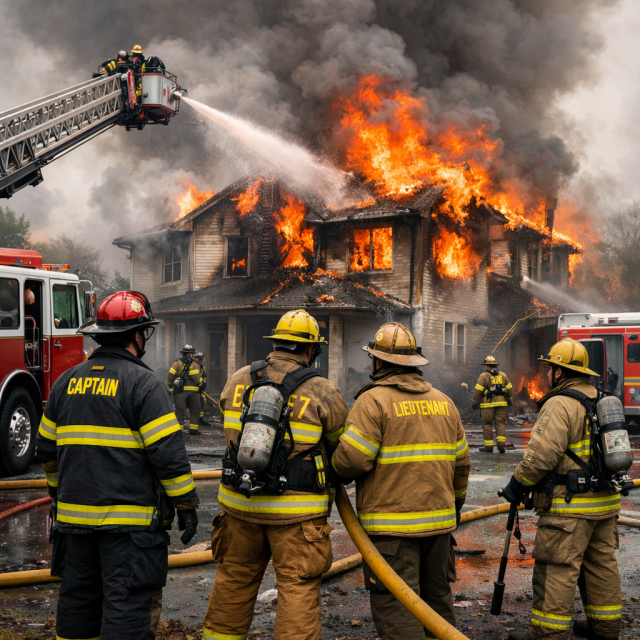
When the first-arriving company officer assumes command of a working fire before the arrival of a chief officer, the entire trajectory of the incident is often shaped within the first several minutes. Those early decisions influence firefighter safety, survivability for occupants, fire spread, accountability, communications, and ultimately the outcome of the incident. The company officer who can rapidly transition from crew supervisor to incident commander provides the department with stability during the most chaotic phase of the fire.
In many fire departments, especially combination, suburban, or smaller municipal organizations, company officers routinely function as the initial incident commander. This role requires far more than transmitting a brief radio report. It demands disciplined situational awareness, command presence, tactical prioritization, and the ability to balance operational aggressiveness with risk management.
Establishing Command Immediately
One of the most important practices for the first-arriving officer is to formally establish command early and clearly. Confusion develops quickly when multiple companies arrive and nobody knows who is directing the incident.
A concise initial radio report should include:
- Unit arrival
- Building description
- Conditions showing
- Apparent occupancy
- Strategy mode
- Initial action assignment
- Establishment of command
A strong example might sound like:
“Engine 3 on scene. Two-story residential structure with heavy fire showing from the Alpha-Bravo corner on the first floor. Engine 3 initiating an offensive attack with a primary search. Maple Street Command established.”
This brief report immediately provides incoming companies with orientation and direction.
Company officers should avoid vague transmissions such as “we’ve got smoke showing” or “working fire.” Incoming resources need specific, tactical information.
Conducting a Fast but Effective Size-Up
The initial size-up remains one of the most critical responsibilities of the officer assuming command. Experienced officers understand that fires are won or lost based on reading conditions correctly.
The officer should rapidly evaluate:
- Building construction
- Fire location and extent
- Smoke conditions
- Occupancy type
- Time of day
- Victim potential
- Exposures
- Structural stability
- Water supply
- Access and egress issues
A proper 360-degree assessment, when feasible, dramatically improves tactical decision-making. Too many company officers rush directly into the structure without identifying basement fires, rear involvement, compromised structural components, or trapped occupants visible from other sides.
The officer must resist tunnel vision. The visible fire from Side Alpha is rarely the entire incident.
Declaring the Strategy Early
One of the best leadership practices for company officers is clearly identifying the operational strategy:
- Offensive
- Defensive
- Transitional
- Rescue mode
Incoming units should not have to guess whether crews are operating inside or outside.
If the officer decides on an offensive strategy, that commitment requires:
- Coordinated hoseline advancement
- Search operations
- Ventilation control
- Rapid intervention capability
- Continuous fire condition evaluation
If conditions deteriorate or survivability decreases, the officer must have the discipline to change strategy quickly. Pride has injured and killed firefighters when officers delayed transitioning to defensive operations.
Good officers constantly ask:
“Are conditions improving because of our actions, or are we losing control of the building?”
Maintaining Crew Integrity
A dangerous trap for first-arriving officers is becoming so absorbed in command responsibilities that they lose accountability for their own crew.
When the officer enters with the crew, command becomes fast-attack mode temporarily. In this mode, the officer must still:
- Track crew location
- Monitor air consumption
- Maintain radio discipline
- Watch fire behavior
- Identify collapse indicators
- Monitor changing conditions
Many line-of-duty deaths occur because officers become task-saturated.
A disciplined company officer delegates operational tasks when possible and avoids freelancing behavior.
Prioritizing Life Safety
The first company officer frequently determines whether viable rescues occur. That does not mean every visible fire requires reckless interior operations.
Professional officers conduct a survivability assessment that considers:
- Occupant profile
- Fire location
- Time of day
- Smoke conditions
- Tenability
- Reports of trapped victims
Rescue operations should be coordinated and purposeful. Blind searches without hoseline protection in rapidly deteriorating conditions often create additional victims.
Aggressive does not mean uncontrolled.
The best officers combine urgency with discipline.
Managing Communications Effectively
Radio discipline becomes increasingly important before a chief officer arrives. Early communications often become cluttered with unnecessary traffic.
Strong company officers:
- Keep radio reports concise
- Provide benchmark updates
- Acknowledge assignments
- Request resources early
- Announce strategy changes immediately
Critical benchmarks include:
- Water on the fire
- Primary search complete
- Secondary search complete
- Fire under control
- PAR checks
- Transition to defensive operations
An officer who communicates clearly reduces confusion for dispatch, incoming units, and mutual aid companies.
Building the Incident Organization Early
Even before chief officers arrive, experienced company officers begin organizing the incident structure mentally.
This includes assigning:
- Attack line
- Backup line
- Search group
- Ventilation group
- Water supply
- Rapid intervention team
- Exposure protection
As additional companies arrive, the officer should avoid micromanaging every firefighter individually. Instead, assignments should be given by company or division whenever possible.
This creates scalability as the incident grows.
Understanding When to Transfer Command
One of the most overlooked leadership skills is conducting a proper transfer of command when a chief officer arrives.
A professional transfer should include:
- Current strategy
- Building layout
- Fire location and extent
- Completed assignments
- Outstanding tactical needs
- Accountability status
- Water supply status
- Safety concerns
Poor command transfer creates operational gaps and increases risk.
The company officer should remain engaged after transfer and continue supervising their crew effectively.
Remaining Calm Under Pressure
Firefighters closely watch the demeanor of the first-arriving officer. Panic, emotional radio traffic, and rushed decision-making spread rapidly through the fireground.
The best company officers project controlled urgency.
They:
- Speak calmly
- Think systematically
- Avoid emotional reactions
- Slow themselves mentally despite the chaos
- Continually reassess conditions
A calm officer improves firefighter confidence and operational effectiveness.
Conclusion
The first company officer on scene often carries the responsibility of incident command during the most volatile stage of a structure fire. Effective officers understand that command is not simply giving orders — it is managing risk, maintaining accountability, organizing resources, reading fire behavior, and protecting both civilians and firefighters.
The transition from riding seat officer to incident commander requires preparation long before the alarm sounds. Officers who train on strategy, communications, building construction, fire behavior, and tactical decision-making place themselves in position to succeed when the chief has not yet arrived.
In the fire service, the first several minutes matter enormously. A disciplined, organized, and tactically sound company officer can stabilize the incident, support incoming resources, and create the foundation for a successful operation long before the command vehicle pulls onto the scene.

