A Mission or an Assignment
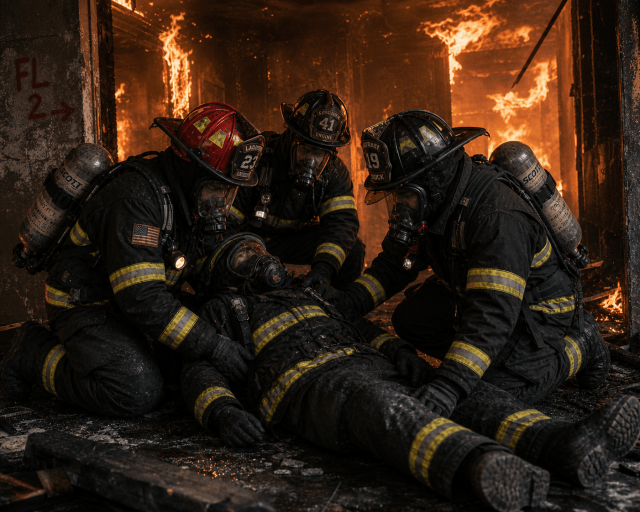
When a firefighter goes down inside an IDLH environment, the operation shifts immediately from fire control to firefighter survival. The Rapid Intervention Team (RIT) becomes the most critical element on the fireground. For company officers, supervising RIT is not passive oversight—it is an active, disciplined function that demands anticipation, control, and tactical precision.
1. Build RIT Before You Need It
Effective RIT operations start long before a Mayday is transmitted.
A company officer must ensure the team is:
- Fully equipped (RIT pack, search rope, TIC, irons, wire cutters, stokes or drag device)
- Positioned strategically (near entry point, but not committed to other tasks)
- Briefed on current fireground conditions, building layout, and crew locations
This is not a staging assignment—it is a mission-ready posture. The officer should constantly reinforce that RIT is not a reserve labor pool. The temptation to reassign RIT to fire attack or ventilation must be resisted.
2. Maintain Situational Awareness at a Higher Level
While interior crews focus on tactical objectives, the RIT officer must think differently. Their perspective is broader and more predictive.
Key responsibilities include:
- Monitoring radio traffic continuously for stress indicators or missed benchmarks
- Tracking crew assignments, entry points, and expected egress routes
- Identifying hazards that could trap or disorient firefighters (collapse zones, flow path changes, deteriorating conditions)
A strong RIT officer is mentally mapping the structure and constantly asking:
“If someone calls a Mayday right now, where are they likely to be, and how do we get to them fastest?”
3. Control the Team—Don’t Freelance
When a Mayday occurs, chaos is the enemy. The RIT officer must impose structure immediately.
Best practices:
- Confirm the Mayday information (WWW: Who, Where, What) or (LUNAR: Location, Unit, Name, Assignment, Resources needed)
- Deploy with a clear entry point and objective
- Assign roles within the team (search, air management, disentanglement, packaging)
Freelancing kills coordination. The officer must maintain:
- Crew integrity
- Accountability
- Clear communication with Command
No member of RIT should operate independently without direction.
4. Air Management is the First Priority
Most downed firefighter situations are air-related before they are trauma-related.
The RIT officer must ensure:
- Immediate location and confirmation of the firefighter
- Rapid assessment of SCBA status
- Deployment of the RIT air pack without delay
This requires training discipline. أعضاء who hesitate or fumble with the RIT pack waste critical seconds. Officers must drill this repeatedly so it becomes automatic under stress.
5. Slow Down to Move Fast
A common failure in RIT operations is rushing without coordination. Speed is critical—but uncontrolled speed leads to missed steps, lost orientation, and additional Maydays.
The officer should enforce:
- Oriented search techniques
- Constant physical or verbal contact
- Deliberate movement toward the objective
A controlled, methodical approach often results in faster overall rescue because it prevents compounding problems.
6. Communicate with Command—Relentlessly
The RIT officer is the link between the rescue operation and the Incident Commander.
Provide:
- Regular progress reports
- Updated location of the downed firefighter
- Resource needs (additional RIT, hoseline protection, extrication tools)
Clear communication allows Command to:
- Support the rescue effort
- Control the fire environment
- Prevent additional crews from interfering with RIT operations
7. Anticipate the Removal Problem
Finding the firefighter is only half the battle. Removal is often the most complex and physically demanding phase.
The officer must think ahead:
- What is the egress route?
- Are stairs, windows, or wall breaches needed?
- Is a hoseline required for protection during removal?
Pre-planning during the standby phase should include identifying potential secondary exits and obstacles.
8. Integrate with Fireground Strategy
RIT does not operate in isolation. The officer must coordinate with Command to ensure:
- Fire conditions are being controlled to support rescue
- Ventilation is aligned with rescue efforts (not worsening conditions)
- Backup RIT is established
This is where experienced officers stand out—they understand that firefighter rescue is a system-wide operation, not just a team function.
9. Train for the Worst Day
RIT performance is built on repetition under realistic conditions.
Company officers should emphasize:
- Low-visibility, high-heat training environments
- Full gear, SCBA, and realistic obstacles
- Scenario-based Mayday drills (entanglement, collapse, disorientation)
Training must push firefighters beyond comfort, because the real event will.
10. Lead with Composure
Finally, the tone of the RIT operation is set by the officer. Panic spreads fast. So does confidence.
A composed officer:
- Speaks clearly and deliberately
- Maintains control of assignments
- Keeps the team focused on priorities
In a Mayday, firefighters will default to their training—but they will also mirror their leader.
Closing Perspective
Supervising a Rapid Intervention Team is one of the most demanding responsibilities a company officer will face. It requires discipline before the incident, awareness during the incident, and leadership when everything goes wrong.
The difference between a successful rescue and a tragic outcome often comes down to one factor:
A prepared, assertive, and tactically sound company officer who treats RIT as a mission—not an assignment.

