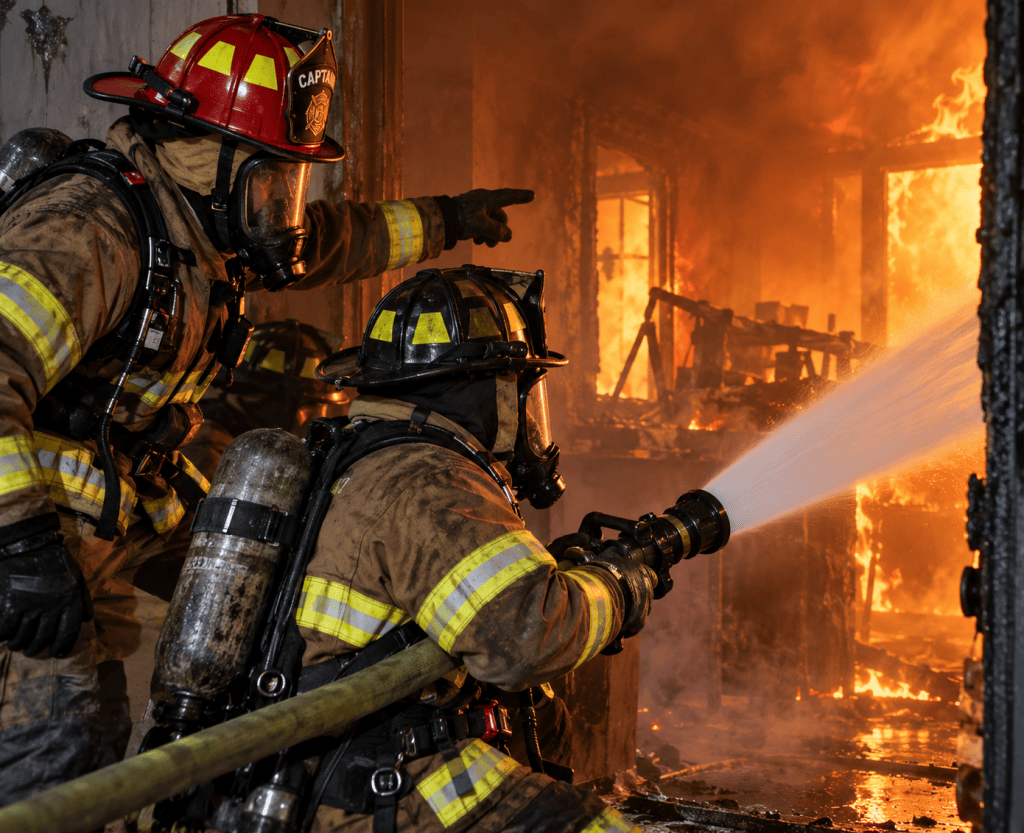
On an engine company, few assignments have a more immediate effect on the outcome of a working fire than the firefighter operating the nozzle. The nozzle firefighter is positioned at the leading edge of the fire attack, where decisions involving movement, water application, air management, and changing fire conditions can determine whether the company advances or retreats.
A capable nozzle firefighter is not developed simply by teaching someone how to open and close a nozzle. Company officers must deliberately develop firefighters who understand what the hoseline is supposed to accomplish and can effectively operate it under difficult fireground conditions.
Start With the Fundamentals
Effective nozzle work begins long before the company encounters a working fire. Firefighters need repeated experience stretching, advancing, and operating charged hoselines.
Company officers should make hose deployment a routine component of company-level training. Firefighters should stretch from the apparatus, estimate stretches, manage corners, negotiate stairs, move through doorways, and advance through confined spaces.
The objective is to make basic hose-handling skills automatic.
At a working fire, firefighters should not be trying to remember how to move a charged line around a corner. Their attention should be focused on fire conditions, their crew, their air supply, and the environment ahead of them.
Repetition creates efficiency, and efficiency creates capacity for better decision-making.
Teach the Firefighter to Read the Fire
The nozzle firefighter needs to understand more than hose mechanics. They must understand fire behavior.
Company officers should continually connect fire behavior concepts to nozzle operations. Smoke conditions, heat, ventilation, building configuration, flow paths, and changes in the environment all provide information about what is occurring ahead of the attack team.
Instead of simply telling a firefighter when to flow water, officers should ask:
What are you seeing?
What is the smoke telling you?
Where do you believe the fire is located?
Where is the air entering?
Where are the fire gases moving?
What do you expect to happen when this door opens?
These conversations develop firefighters who think rather than simply follow.
Teach Them to Flow Water Effectively
The purpose of the attack line is to apply enough water to overcome the heat being generated by the fire.
Nozzle firefighters therefore need confidence in flowing water.
Training should reinforce proper nozzle position, stream placement, nozzle reaction management, and effective movement while flowing. Firefighters should understand the capabilities and limitations of the nozzle and hoseline their department uses.
Just as importantly, company officers should eliminate the idea that conserving water by unnecessarily closing the nozzle is good nozzle discipline.
Once fire attack is initiated and water is effectively reaching the fire compartment, interruption of the stream can allow heat release to increase again. The nozzle firefighter should understand when continuous application is appropriate and when conditions require repositioning or a change in tactics.
The goal is not simply to flow water.
The goal is to put water where it will have the greatest effect.
Develop Movement and Coordination
A good nozzle firefighter cannot operate effectively without a good backup firefighter.
Company officers should train nozzle and backup firefighters as a team rather than as separate positions. The backup firefighter should manage hose, absorb nozzle reaction, communicate conditions, and provide the nozzle firefighter enough working line to advance.
The nozzle firefighter should not have to fight both the fire and the hose.
Crews should practice coordinated movements such as:
- Advancing while flowing.
- Moving around corners.
- Advancing up and down stairs.
- Operating through doorways.
- Repositioning inside rooms.
- Managing hose behind the nozzle.
- Advancing through restricted spaces.
- Withdrawing while maintaining fire control.
When nozzle and backup firefighters learn to anticipate each other’s movements, the attack line becomes significantly more effective.
Teach Positioning, Not Just Advancement
Aggressiveness and effectiveness are not synonymous.
The best nozzle firefighter is not necessarily the firefighter who advances the fastest. It is the firefighter who recognizes where the line needs to be positioned to control the fire while maintaining a tenable operating position.
Company officers should teach firefighters to use walls, doorways, corners, and other structural features to their advantage. Firefighters should understand how to operate from positions that maximize stream reach while limiting unnecessary exposure.
Sometimes the correct action is advancement.
Sometimes it is holding a doorway.
Sometimes it is repositioning.
And sometimes deteriorating conditions require withdrawal.
Developing that judgment requires realistic training and good company officers.
Build Confidence Under Realistic Conditions
Parking-lot hose drills are valuable, but they cannot be the end of nozzle training.
Firefighters must learn to operate when visibility is poor, communication is difficult, the hoseline is dragging against multiple corners, and physical exertion is increasing.
Training should progressively introduce complications.
Black out the facepiece. Add furniture and obstacles. Advance upstairs. Create narrow hallways. Require communication with the officer. Make the firefighter manage the line while monitoring air consumption.
When permitted and conducted under applicable live-fire training requirements, live-fire evolutions provide an opportunity to connect hose-handling skills with heat, fire behavior, water application, and changing conditions.
The purpose is not to see how much punishment a firefighter can tolerate. The purpose is to develop competence under increasingly realistic conditions.
Make the Nozzle Firefighter Think Ahead
Experienced firefighters often appear faster because they anticipate what will happen next.
Company officers should develop that same ability in newer nozzle firefighters.
Before entering, ask where they expect the fire to be.
Before climbing the stairs, ask where they want the hose positioned.
Before opening a door, ask what might happen.
Before entering the fire room, ask where they intend to direct the stream.
After the evolution, ask what they would do differently.
These short conversations develop tactical thinking without requiring elaborate training scenarios.
Eventually, the firefighter begins asking those questions internally.
That is professional development.
Correct Problems During Training
The working fire is the wrong place to discover that a firefighter cannot control nozzle reaction, advance a charged line, recognize deteriorating conditions, or communicate effectively.
Company officers have an obligation to identify weaknesses during training and correct them.
Correction should be specific.
Instead of saying, “You need to get better with the nozzle,” identify the actual problem:
“You are carrying too much hose in front of you.”
“You are outrunning your backup firefighter.”
“You stopped flowing before the fire was controlled.”
“You are looking at the floor instead of reading conditions ahead.”
“You aren’t communicating what you’re seeing.”
Specific feedback gives firefighters something they can actually improve.
Let Firefighters Spend Time on the Nozzle
Perhaps the simplest way to develop better nozzle firefighters is to give them nozzle time.
Officers sometimes rely repeatedly on their most experienced firefighter because that person is already proficient. While understandable on significant incidents, continually assigning the same person to the nozzle prevents other firefighters from developing.
Training provides the opportunity to rotate positions.
Put newer firefighters on the nozzle. Let them struggle. Coach them. Reset the evolution and do it again.
Then increase the difficulty.
Competence comes from repetitions, not lectures.
The Company Officer Develops the Nozzle Firefighter
A strong engine company does not happen accidentally.
It is built through repeated stretches, honest evaluation, realistic training, and officers who are willing to teach the details of the job.
The company officer should be developing firefighters who can stretch efficiently, control the nozzle, move a charged line, read smoke and heat conditions, understand fire behavior, communicate with the crew, manage their air, and recognize when conditions are changing.
Most importantly, the officer should develop firefighters who understand why they are performing each action.
At a working fire, the nozzle firefighter may be operating only a few feet in front of the company officer, but those few feet matter enormously. That firefighter is making constant decisions about movement, positioning, water application, and conditions.
The better prepared that firefighter is, the more capable the entire engine company becomes.
Don’t wait for the working fire to develop your nozzle firefighter. Develop them at the station so they are ready when the working fire arrives.

