
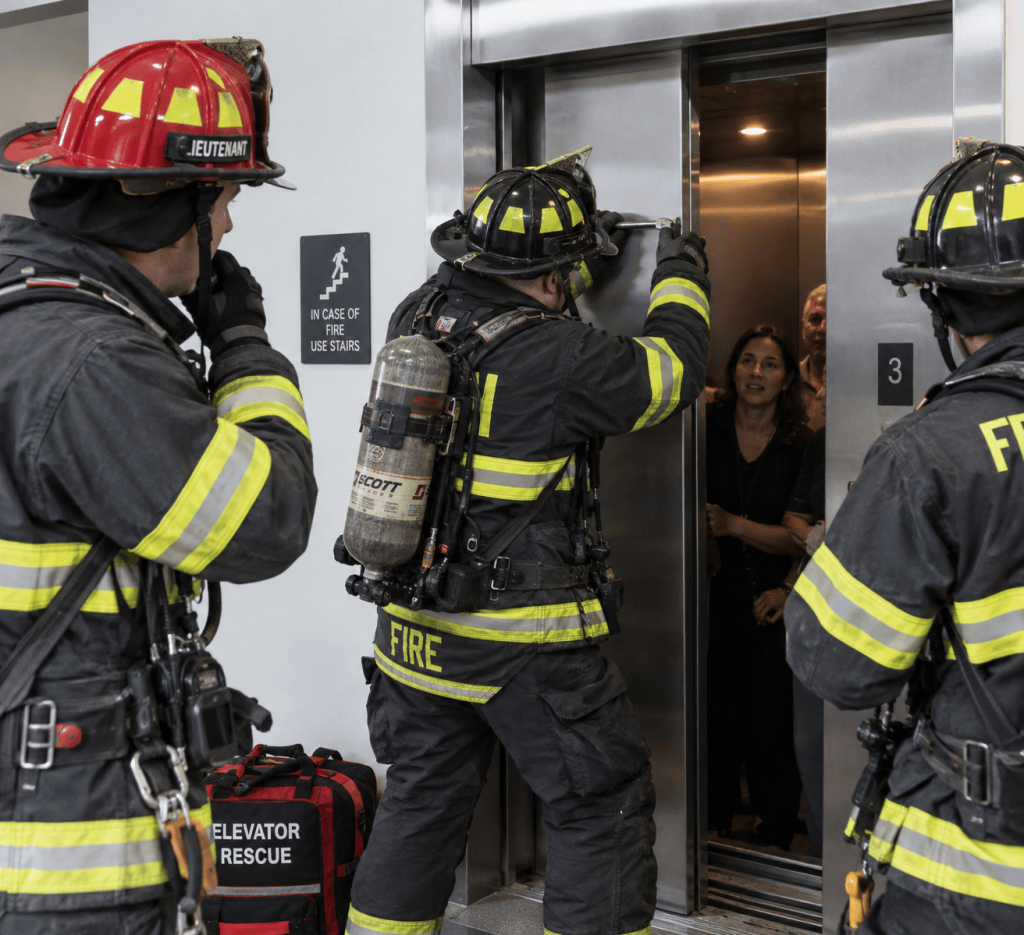
Elevator rescues are not among the most frequent emergencies a fire company will encounter, but they can quickly become technically challenging incidents. What initially sounds like a routine call for occupants stuck in an elevator may involve an electrical or mechanical malfunction, an elevator stopped between floors, a medical emergency inside the car, or occupants attempting to self-rescue. For the company officer, the key is to prevent a relatively controlled situation from in becoming an emergency involving rescuers or occupants.
Begin With Size-Up, Not the Elevator Keys
One of the most important practices for a company officer is resisting the temptation to immediately begin manipulating the elevator. Upon arrival, the officer should first establish exactly what has occurred. Determine which elevator is involved, the approximate location of the car, the number and condition of occupants, and whether there are indications of smoke, fire, flooding, electrical problems, mechanical damage, or other hazards.
Communication with the trapped occupants should begin as early as possible. In many incidents, occupants are frightened but otherwise safe. Reassuring them that firefighters are on scene and instructing them to remain inside the car can prevent dangerous attempts at self-rescue.
The officer should also determine whether anyone inside is experiencing a medical emergency. A person reporting chest pain, respiratory distress, altered mental status, severe anxiety, or another significant medical condition changes the urgency of the operation and may justify requesting additional resources.
Understand the Difference Between Rescue and Removal
Not every stalled elevator requires an immediate technical rescue. If occupants are secure inside a properly positioned car and there is no immediate threat, the safest solution may involve working with building maintenance or a qualified elevator technician rather than forcing entry.
The company officer should distinguish between an occupant removal and a true elevator rescue emergency. That distinction affects the risk firefighters should accept.
An elevator car is generally a relatively protected environment when there is no fire, smoke, medical emergency, or mechanical instability. Creating openings, accessing the hoistway, or moving occupants through unconventional exits can introduce hazards that did not previously exist.
Control the Elevator’s Energy
Elevator incidents should be approached with the same respect for hazardous energy that firefighters apply at machinery and industrial rescues. The company officer must ensure that appropriate electrical and mechanical hazards are controlled before firefighters enter a hoistway or place themselves in a position where unexpected elevator movement could cause injury.
Simply pressing a stop button should not automatically be considered sufficient protection for personnel entering a hazardous area. Firefighters must follow departmental procedures and the elevator manufacturer’s or qualified technician’s guidance for securing the system.
The officer should assign personnel to control critical locations and make certain that no one restores power or operates elevator controls while firefighters are exposed to moving equipment.
This is where disciplined command becomes particularly important. Everyone operating at the incident needs to understand whether the elevator is energized, who controls that energy, and what must occur before its status can be changed.
Maintain Control of the Hoistway
One of the greatest hazards at an elevator incident is the hoistway itself. Once a hoistway door is opened without an elevator car properly positioned behind it, firefighters have created a significant fall hazard.
The company officer should strictly control access to any open hoistway. Unnecessary personnel, building occupants, and bystanders should be kept away. Firefighters working near an opening should use appropriate fall-protection measures consistent with department SOPs, training, equipment, and the circumstances encountered.
An open hoistway door should never become an unattended hazard.
The officer must also maintain awareness that the elevator car may not be exactly where occupants believe it is. Before opening doors or beginning removal, firefighters should positively establish the location and position of the car.
Use the Simplest Safe Rescue Method
Good technical rescue operations generally progress from the least complicated and least hazardous option toward more technical alternatives.
If the elevator car is properly aligned with a landing and departmental procedures allow firefighters to safely open the doors, occupant removal may be straightforward. A car stopped significantly above or below the landing presents a different problem.
Company officers should be particularly cautious about allowing occupants to climb up or down through a partially accessible elevator doorway. The space between the car and landing can expose someone to the hoistway. A frightened occupant can slip, fall, or move unpredictably.
Similarly, removing occupants through the top of an elevator car should not be treated as a routine alternative. Top-of-car operations can expose rescuers and occupants to fall hazards, electrical equipment, machinery, confined spaces, and unexpected car movement. These operations require appropriate training, equipment, hazard control, and often additional technical-rescue resources.
The objective is not simply to get the occupants out quickly. The objective is to remove them without creating a greater hazard than the one that originally trapped them.
Establish Command and Assign Responsibilities
Even relatively small elevator incidents benefit from basic incident command principles. The first company officer should establish command, perform the size-up, and assign specific responsibilities.
Depending on the complexity of the incident, assignments may include elevator control, occupant communication, lobby or access control, electrical control, upper-floor operations, medical standby, and rescue operations.
Accountability is particularly important if personnel enter machine rooms, hoistways, elevator pits, or other areas outside normal building spaces. The officer should always know where crews are operating and what hazards they are encountering.
More complicated situations may require additional companies, technical-rescue personnel, EMS resources, building engineers, utility representatives, or elevator technicians. Calling these resources early is preferable to waiting until firefighters have already committed themselves to a difficult operation.
Coordinate With Elevator Professionals
Firefighters bring emergency-management and rescue capabilities to the incident, but elevator technicians possess specialized knowledge of elevator machinery and control systems. When conditions permit, the company officer should use that expertise.
A qualified technician may be able to identify the malfunction, safely position the car, secure components, or recommend the safest method for accessing occupants.
The presence of an elevator technician does not eliminate the fire department’s responsibility for scene safety. Likewise, firefighters should not attempt complicated mechanical procedures simply because they have successfully performed basic elevator removals in the past. Effective incident management recognizes the limits of each discipline and combines the appropriate expertise.
Prepare for the Occupants
The rescue does not end when the elevator doors open. Occupants may have been confined for an extended period and could be anxious, overheated, dehydrated, or experiencing medical problems.
Firefighters should control the exit rather than allowing everyone to rush from the elevator simultaneously. If there is a difference in elevation between the car and landing, occupants may need individual assistance.
Children, older adults, people with mobility limitations, and anyone reporting illness or injury deserve particular attention. EMS evaluation should be readily available when indicated.
Know When the Incident Has Escalated
Company officers must recognize when a routine elevator call has moved beyond the capabilities of the initial company. Warning signs include an elevator significantly displaced from a landing, damaged suspension or mechanical components, occupants requiring removal through the roof hatch, rescuers needing to enter the hoistway, significant water entering the elevator system, fire or smoke conditions, or any situation requiring rope or technical rescue systems.
At that point, the officer’s responsibility is not to improvise. It is to stop, isolate the hazard, request the appropriate resources, and develop a more deliberate rescue plan.
This is one of the defining characteristics of effective company-level leadership: knowing the difference between something that can be attempted and something that should be attempted.
Train Before the Alarm
Elevator rescue is difficult to learn while occupants are waiting inside a stalled car. Company officers should incorporate elevator emergencies into regular company training.
Crews should become familiar with elevator types within their response district, emergency controls, elevator keys, machine-room locations, electrical disconnects, door-opening procedures, firefighter emergency operation, hoistway hazards, and departmental lockout/tagout procedures. High-rise buildings, hospitals, hotels, apartment complexes, parking facilities, and other properties containing multiple elevators are particularly valuable locations for preincident familiarization.
Whenever possible, this training should include building engineers and qualified elevator personnel. Seeing an elevator system under controlled conditions gives firefighters a much better understanding of what exists behind the doors they routinely encounter.
The Company Officer Sets the Tempo
The greatest contribution a company officer can make at an elevator rescue is disciplined supervision. These incidents frequently present a dangerous combination: anxious occupants, firefighters who want to solve the problem quickly, and machinery whose hazards may not be immediately visible.
The officer must slow the operation enough to identify those hazards while maintaining enough urgency to address legitimate threats to the occupants.
A professional elevator rescue should therefore follow a deliberate progression: size up the situation, communicate with the occupants, locate the car, establish command, control hazardous energy, secure the hoistway, select the least hazardous removal method, and escalate to specialized resources when necessary.
Successful elevator rescue operations are rarely defined by dramatic tactics. They are defined by hazard recognition, technical competence, communication, accountability, and restraint. For the company officer, that is the fundamental leadership lesson: do not turn a stalled elevator into a rescue emergency through hurried or unnecessary actions.

