
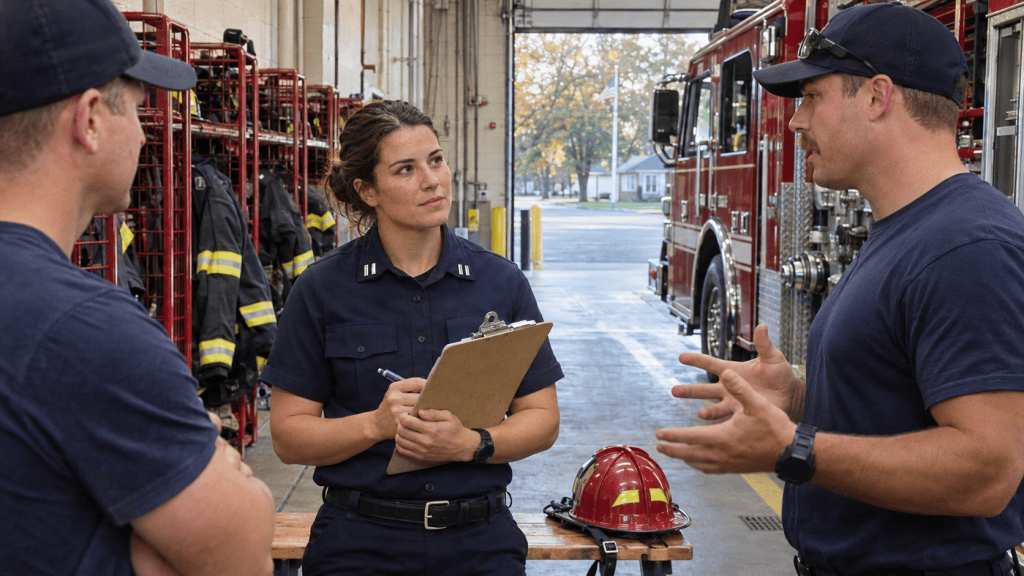
On your first shift after promotion, the crew may look to you to settle a disagreement, explain a new department policy, and decide whether the afternoon drill needs to be repeated. By dinner, you may have handled all three and still be wondering whether you handled any of them well. That’s a normal part of becoming a company officer. You’ve spent years learning what your officer does. Now you’re learning what it feels like to be responsible for those decisions.
For a newly promoted officer assigned to a regular crew, I’d use the first 90 days to find your footing, the first year to become dependable in the role, and the second year to deepen your judgment. Treat that as a planning guide. An officer promoted within a familiar house may learn the daily routine quickly. An officer rotating through several stations may need more time to understand how each crew works and earn enough trust for people to speak candidly. Either way, count the quality of your repetitions as much as the months on the calendar.
The first 90 days: Learn the crew and establish expectations
Start by getting the everyday work right. Learn who needs coaching, who can teach a skill well, and which responsibilities tend to fall through the cracks when the station gets busy. Be clear about what you expect on apparatus checks, training, and follow-up. If a firefighter tells you something needs attention, close the loop, even if all you can provide that shift is an update.
This is also when many new officers feel the strain of supervising people who were recently their peers. The first time you need to correct a friend, keep the conversation private and specific. Explain what you observed, what you expect, and when you’ll follow up. Handling that conversation fairly will do more to establish your credibility than a long speech on your first day.
The first year: Become someone the crew can count on
Over the course of a year, you’ll have more chances to see how your decisions hold up. Can you keep a training plan going through a busy stretch? Can you give a capable firefighter room to lead a drill and still hold the crew to the standard? Can you bring an issue to the battalion chief early enough for them to help?
Find an experienced officer you trust and give them something specific to critique. Ask them to observe a drill briefing or walk through a recent call with you. “What did you hear in my instructions?” will get you more useful feedback than “How am I doing?” For situations you rarely encounter, use drills and tabletop discussions to practice the decisions you’ll be expected to make.
The second year: Get better at seeing what’s coming
As the routine becomes familiar, you can spend more attention on what’s developing around you. You might notice that a normally engaged firefighter has stopped asking questions, or that the crew performs a skill well only when the same person leads it. Those observations give you a chance to coach early, vary assignments, or adjust the training plan.
One sign you’re learning to do the job well is that your crew brings you problems while there’s still time to solve them. They know you’ll listen, make a decision, and follow through. Some shifts will still leave you replaying a conversation on the drive home. When that happens, pick one thing you’d handle differently and put it into practice next shift. A year of doing that gives you a much better measure of your progress than a year marked off on the calendar.

