Effective ventilation is one of the most decisive tactical functions on the fireground. When executed correctly, it directly improves tenability, visibility, and interior conditions for both victims and firefighters. When executed poorly—or at the wrong time—it can rapidly accelerate fire growth and place crews at extreme risk. Getting the best out of your ventilation team, therefore, requires a combination of leadership, timing, coordination, and technical competence.
The “Why”
High-performing ventilation crews are not just tool operators—they are tacticians. Fire company officers must ensure their firefighters understand flow path, fire behavior, and the impact of air movement on heat release rate. Ventilation is not about “cutting a hole” or “breaking windows”—it is about controlling the environment.
Your team should understand:
How ventilation introduces oxygen and can intensify fire conditions The relationship between ventilation and fire attack (coordination is non-negotiable) The difference between vertical and horizontal ventilation and when each is appropriate Indicators of ventilation-limited vs. fuel-limited fires
When firefighters understand the consequences of their actions, they operate with discipline instead of routine.
Train for Precision, Not Just Speed
There is a tendency to equate good ventilation with fast ventilation. Speed matters—but precision matters more. A poorly placed ventilation opening can be ineffective or even dangerous.
Focus training on:
Proper hole placement (over the seat of the fire whenever possible) Size and effectiveness of openings (adequate exhaust vs. ineffective cuts) Saw handling under realistic conditions (pitch, footing, smoke, noise) Roof size-up and structural awareness (truss vs. legacy construction, collapse indicators)
Repetition under realistic conditions builds competence. Competence builds confidence. Confidence leads to controlled execution under pressure.
Assign Clear Roles on the Roof or Ventilation Group
Your ventilation team should operate like a coordinated unit—not a collection of individuals. Assign specific roles:
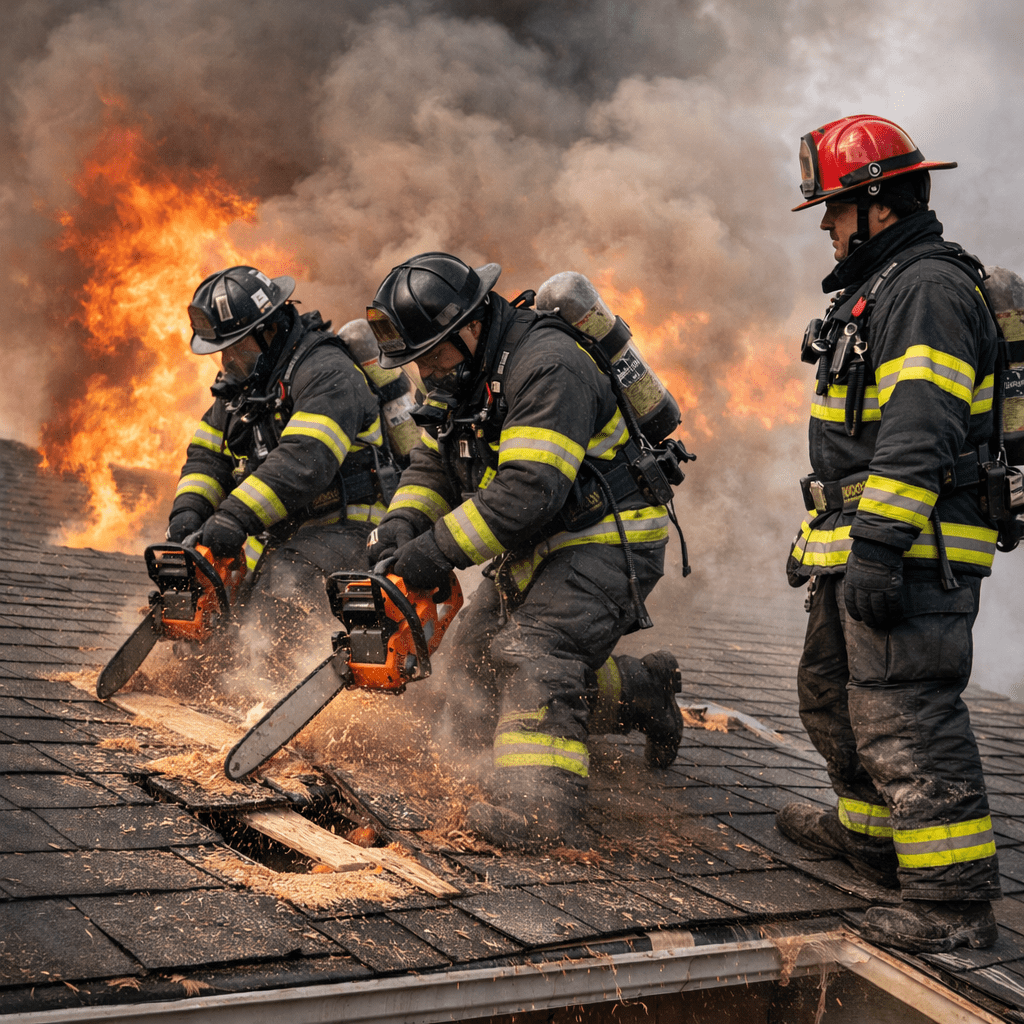
Supervisor (often the officer or senior firefighter): Maintains situational awareness, reads smoke/fire conditions, ensures coordination with interior crews Primary saw operator(s): Executes cuts Backup firefighter: Assists with tool management, monitors roof conditions, provides safety oversight
The presence of a clearly identified supervisor—like the firefighter in the red helmet in your scenario—is critical. That individual should not be task-saturated with cutting; their job is to think, read conditions, and coordinate.
Coordination Is the Difference Between Success and Disaster
Ventilation must be coordinated with fire attack. This is where many operations succeed or fail.
Key coordination principles:
Do not ventilate until water is ready or being applied (unless performing life-saving vent-enter-search operations) Maintain communication between ventilation and interior crews Understand that ventilation without suppression increases fire intensity
A well-timed ventilation opening can dramatically improve interior conditions. A poorly timed one can trigger rapid fire development or flashover.
Critical Points During a Fire When Ventilation Is Essential
There are several operational benchmarks where ventilation becomes tactically critical:
1. Pre-Entry or Initial Fire Attack (Coordinated)
When crews are preparing to make entry, coordinated ventilation can:
Reduce interior temperatures Improve visibility Increase survivability for trapped occupants
This must be tightly timed with hoseline advancement.
2. Search and Rescue Operations
Ventilation improves tenability and increases the likelihood of victim survival. Horizontal ventilation (targeted window removal) or VES (Vent-Enter-Search) may be used when:
Victims are suspected inside Conditions are rapidly deteriorating
This is one of the few scenarios where ventilation may precede full suppression—but it must be controlled and deliberate.
3. Fire Showing from the Roof / Attic Involvement
When fire has extended into attic spaces or is pushing through the roof:
Vertical ventilation becomes critical to release heat and gases Properly placed cuts can prevent lateral spread and improve interior conditions
Failure to ventilate in these conditions can lead to rapid fire extension and structural compromise.
4. Post-Knockdown Overhaul
After the main body of fire is controlled:
Ventilation removes residual heat, smoke, and toxic gases Improves conditions for overhaul crews Reduces rekindle potential by exposing hidden fire
5. High Heat / Limited Visibility Conditions
When interior crews report extreme heat and zero visibility:
Ventilation can dramatically change interior conditions within seconds Must be coordinated to avoid worsening the environment
Emphasize Safety and Structural Awareness
Your ventilation team operates in one of the most hazardous positions on the fireground—especially on roofs.
Ensure your team consistently:
Sounds the roof and monitors structural integrity Identifies collapse indicators (spongy decking, sagging, heavy fire involvement) Maintains egress routes (ladders placed strategically) Works off ladders or aerials when appropriate
A strong ventilation team is aggressive—but never reckless.
Final Thought
The best ventilation teams are built through disciplined training, strong leadership, and a deep understanding of fire dynamics. As an officer, your role is to ensure your team doesn’t just perform ventilation—they execute it with purpose, timing, and coordination.
When done right, ventilation is a force multiplier. It makes every other fireground function more effective. When done wrong, it becomes a catalyst for tragedy.
Your job is to ensure it’s always the former.
 The Third Bugle