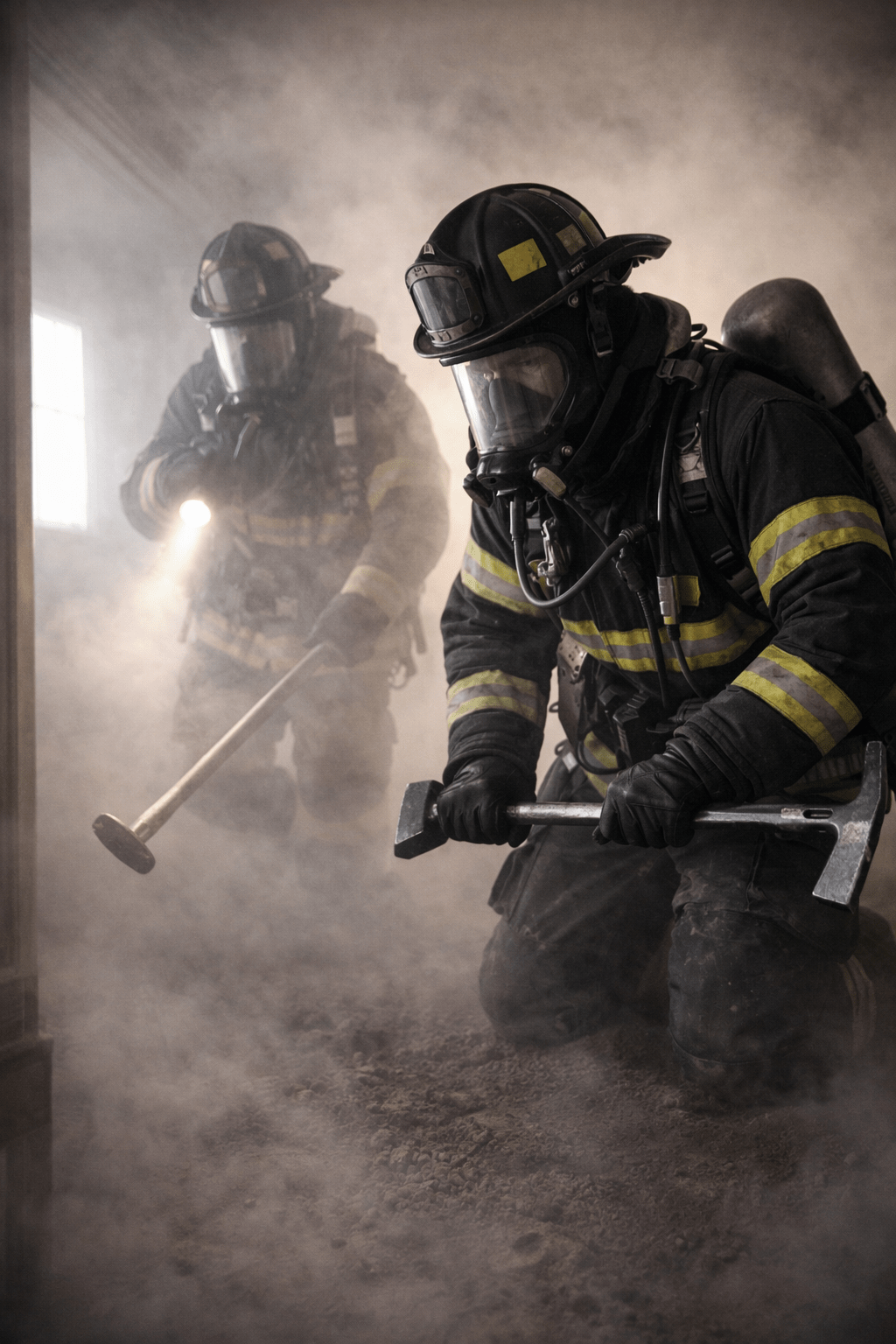
Search and rescue is one of the most time-sensitive, high-risk, and mission-critical functions on the fireground. For the fire company officer, success is not accidental—it is the product of disciplined command presence, tactical clarity, and deliberate control of firefighter behavior inside an immediately dangerous to life and health (IDLH) environment.
At its core, effective search is not about speed alone—it is about coordinated aggression under control.
1. Establish Search as a Tactical Priority—Not an Afterthought
The most effective officers make an early, conscious decision regarding search. That decision is driven by:
Time of day (life hazard probability) Occupancy type and known victim profile Reports of trapped occupants Fire location and growth stage
Search must be integrated into the incident action plan (IAP)—not delayed until after fire control unless conditions dictate.
Best Practice:
Assign search explicitly on arrival or assume it as the first-due company when appropriate. Communicate clearly: “Engine 1 initiating primary search, alpha side, first floor.”
This establishes accountability and sets the tone for disciplined execution.
2. Read the Building Before You Commit Your Crew
Search begins before entry. The officer must perform a rapid size-up that includes:
Building layout and access/egress points Window and door locations (victim egress potential) Fire location relative to likely victim areas (bedrooms, exits) Flow path indicators (smoke movement, air track)
This informs search prioritization, not just entry.
Best Practice:
Target areas of refuge first (bedrooms, behind closed doors). Consider vent-enter-search (VES) for high-probability victim areas when conditions support it.
A disciplined officer does not “wander and hope”—they hunt with purpose.
3. Maintain Crew Integrity and Accountability
Freelancing kills firefighters. The officer’s responsibility is to ensure:
Crew stays together (or operates in assigned pairs with strict accountability) Continuous orientation is maintained (wall, hose line, or search rope) Progress is communicated to command
Best Practice:
Use oriented search whenever possible—one firefighter maintains orientation while others sweep. Conduct periodic verbal or physical check-ins: “Sound off—where are you?”
A lost crew cannot rescue anyone.
4. Control the Pace: Fast Is Fine—Out of Control Is Fatal
Search must be aggressive—but not reckless. Officers must constantly balance:
Speed vs. survivability Visibility vs. orientation Fire conditions vs. tenability
Best Practice:
Slow down at decision points (doorways, stairs, room transitions). Sweep high-probability victim locations thoroughly—beds, closets, behind doors.
Remember: Missing a victim is worse than moving slower.
5. Coordinate with Fire Attack and Ventilation
Uncoordinated fireground operations can rapidly convert survivable spaces into fatal ones.
Search officers must maintain awareness of:
Hoseline location and progress Ventilation timing and type Changing fire conditions (flashover indicators, rollover, heat increase)
Best Practice:
Avoid operating ahead of the hoseline in high heat/fire conditions unless performing targeted VES. Communicate: “Search team operating ahead of fire—conditions deteriorating.”
Search does not occur in a vacuum—it is part of a coordinated system.
6. Prioritize Oriented and Targeted Search Techniques
Random, unstructured searching wastes time and increases risk. High-performing companies use:
Oriented Search
One firefighter maintains a fixed reference (door, hallway, wall) Others search off that orientation point
Targeted Search
Focus on likely victim locations first (beds, couches, egress paths)
VES (Vent-Enter-Search)
Isolate the room Control the door Conduct rapid, focused search
Best Practice:
Match the search method to conditions and staffing. Train repeatedly so these techniques are automatic under stress.
7. Continuously Evaluate Conditions and Survivability
The officer must constantly ask:
Is this environment survivable for victims? Is it survivable for my crew? Are conditions improving or deteriorating?
Indicators such as extreme heat, zero visibility with high velocity smoke, and structural compromise must drive decisions.
Best Practice:
Be willing to withdraw and reposition. Transition from search to fire control support if it improves victim survivability.
Courage is not staying too long—it is making the right call.
8. Communicate Clearly, Concisely, and Frequently
Communication is the backbone of coordinated search.
Transmit:
Assignment and location Progress and areas cleared Victim findings Changing conditions
Best Practice:
Use CAN reports (Conditions, Actions, Needs): “Command from Engine 1: Primary search first floor alpha complete, negative victims, moving to second floor.”
This builds situational awareness across the entire incident.
9. Mark, Control, and Track Your Search
Systematic search requires discipline in tracking progress.
Mark entrances when appropriate Communicate cleared areas Avoid duplication or missed spaces
Best Practice:
Verbally confirm: “Kitchen clear, moving to bravo bedroom.” Maintain a mental or physical map of searched vs. unsearched areas.
Search is a system—not a guess.
10. Train Like You Expect to Perform
No officer can direct an effective search without a well-trained crew.
Training must include:
Zero-visibility search drills Oriented search and VES repetitions Victim removal under realistic conditions Air management and emergency procedures
Best Practice:
Build muscle memory and decision-making under stress. Reinforce expectations: disciplined movement, communication, and accountability.
You will not rise to the occasion—you will default to your training.
Closing Thought: The Officer Sets the Standard
Search and rescue success is a direct reflection of the company officer’s leadership. Firefighters will move as fast, as disciplined, and as effectively as they are directed.
The officer must be:
Decisive in assigning search Tactical in prioritizing areas Relentless in maintaining control Honest in evaluating conditions
Because at the end of the day, search is not just a task—it is a promise:
That we will go where others cannot, find those who cannot save themselves, and bring them out—alive if possible, and always with purpose.
 The Third Bugle